

Is Pumping Dirty Costing You Money?
Did you know your pump may not be operating at peak efficiency unless it’s clean?
This article is particularly relevant for water and wastewater operators, treatment works managers, and maintenance teams responsible for pump performance, reliability and energy efficiency.
Within the water industry, it has become increasingly common to run pumps on Variable Speed Drives (VSDs) to improve efficiency and control. What is less widely known is that modern VSDs can also play an important role in keeping pumps clean, helping to maintain performance and reduce unnecessary energy use.
Why Pumps Become Inefficient Over Time
In water and wastewater applications, pumps rarely operate in clean, controlled conditions. Over time, efficiency losses can occur due to:
- Ragging and fibrous material wrapping around the impeller
- Sediment, grit and debris build-up
- Changes in process conditions that move the pump away from its design point
- Pumps operating at higher speeds than necessary for extended periods
Even when these issues do not cause a full blockage or trigger alarms, they can quietly reduce hydraulic efficiency and increase energy consumption day after day.
Key takeaways
- Dirty pumps reduce output and increase energy consumption
- Variable Speed Drives can actively support pump cleaning
- Small interventions can deliver measurable efficiency gains
- Reducing pump speed correctly can deliver significant energy savings
How a Clean Pump Improves Efficiency
During a visit to a large water site, a pump was found to be running with a small amount of rag and foreign material caught around the impeller. At the time, the pump was processing approximately 900 litres per minute.
By activating the pump cleaning function within the Variable Speed Drive, a short cleaning cycle was completed. After the cycle, pump output increased to 940 litres per minute, with no change to pump speed.
This simple intervention improved pump efficiency by over 4%, achieved solely by clearing debris from the impeller.
Reduced efficiency does not just affect energy use. Fouled pumps can lead to higher motor loading, increased vibration, seal wear and unplanned maintenance. In critical applications, this can also increase the risk of process disruption and emergency callouts.
Over time, even modest efficiency improvements like this can translate into meaningful reductions in energy costs, pump runtime and maintenance intervention.
What Is Pump Cleaning?
Pump cleaning is a feature available within the ABB ACQ580 Variable Speed Drive, developed specifically for water and wastewater applications.
The function allows the drive to:
- Jog the pump
- Reverse rotation where appropriate
- Dislodge rag and debris from the impeller
Pump cleaning cycles can be triggered automatically, scheduled periodically, or activated in response to changes in process conditions such as reduced flow or increased load. This allows cleaning to take place without interrupting operation or requiring manual intervention.
Keeping the impeller clear helps the pump to operate closer to its design point. As a result, the system:
- Maintains higher hydraulic efficiency
- Reduces the time the pump needs to run
- Lowers overall energy consumption
- Helps minimise blockages and unplanned maintenance
Cleaner pumps move the same volume of liquid using less energy, resulting in lower operating costs and improved reliability.
Efficient Pumping: Slower Can Be Better
Cleanliness is only part of the efficiency equation. Pump speed plays an equally important role.
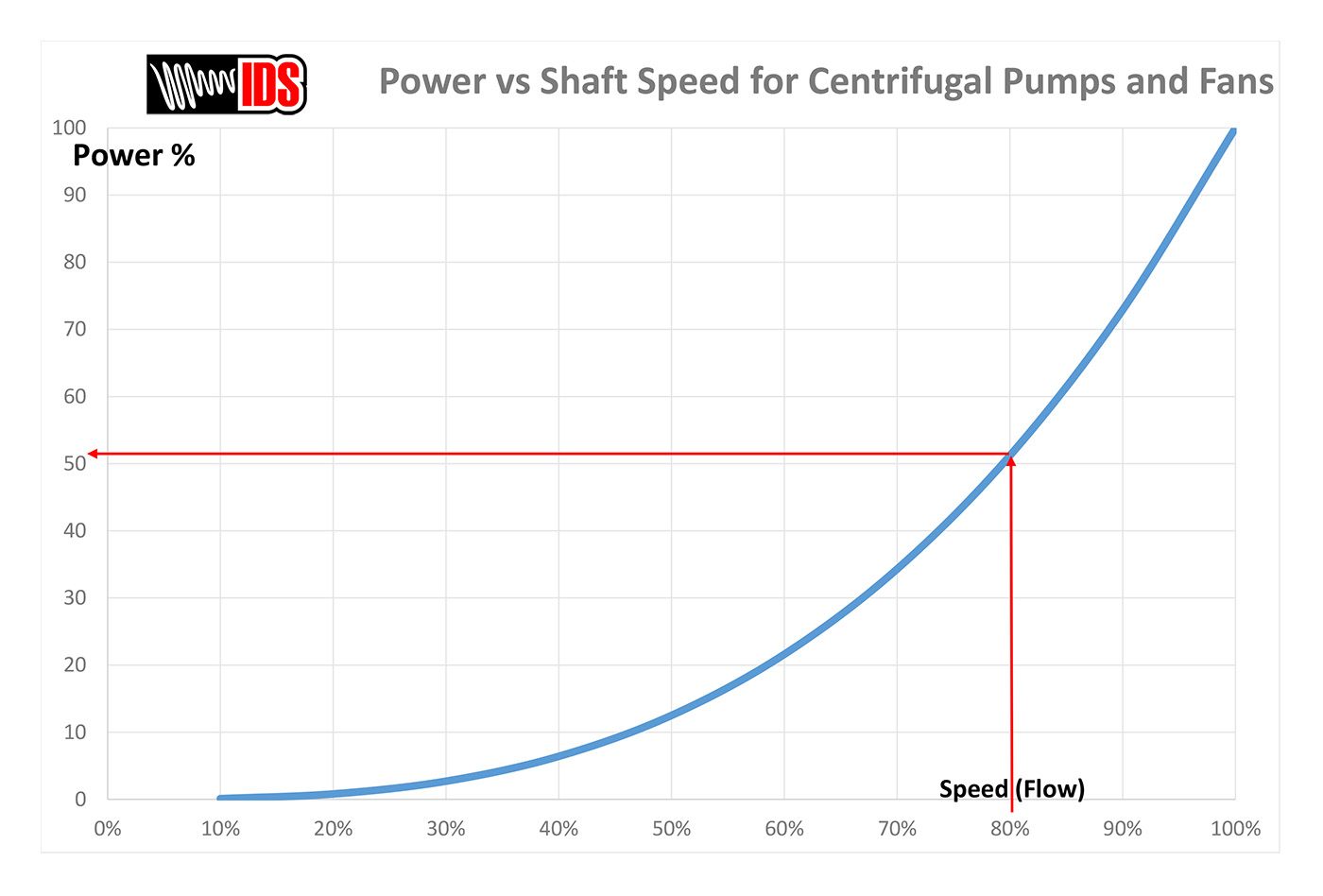
Pumps are a variable torque load, which means energy consumption follows the Affinity (Cube) Laws. This creates significant opportunities for energy reduction when speed is reduced appropriately.
If pump speed is reduced by just 20%, energy consumption can fall by around 50%, while only needing to run slightly longer to achieve the same output.
In practice, many pumps are sized for worst‑case conditions that occur only occasionally. Without speed control, this often results in pumps running faster than required for most of the day. Variable Speed Drives allow output to match real demand, reducing energy use during normal operation while still meeting peak requirements when needed.
When combined with accurate process control, Variable Speed Drives allow pumps to operate at the lowest possible speed for the required duty, maximising efficiency without compromising performance.
Soft insight: If you’re unsure whether slowing your pumps or introducing cleaning cycles could affect your process, an assessment by an experienced drive specialist can remove the uncertainty.
Control Strategy Matters as Much as Equipment
While Variable Speed Drives provide the tools to improve efficiency, the control strategy applied is just as important. Poorly configured systems can still waste energy, even when modern drives are installed.
Effective optimisation considers:
- Process demand and duty cycles
- Minimum and maximum operating speeds
- Interaction with level control and instrumentation
- Long‑term reliability and maintenance impact
This is where application experience makes the difference between theoretical savings and real‑world results.
A Common Misconception About Pump Performance
Common misconception: If a pump is running, it must be operating efficiently.
In reality, even small amounts of rag or debris can significantly reduce output and increase energy use. When combined with unnecessarily high operating speeds, this can lead to excessive energy consumption and avoidable wear.
Variable Speed Drives help address both issues by maintaining clean operation and matching pump speed to actual demand.
Optimising Pump Performance with IDS
At IDS, we work closely with water and wastewater operators to optimise pump performance using Variable Speed Drive solutions, including specialist functionality such as pump cleaning.
Our approach focuses on:
- Understanding how pumps are currently operating
- Identifying efficiency losses caused by fouling or over-speeding
- Applying control strategies that improve reliability and reduce energy use
In many cases, the most effective first step is a motor energy survey, which provides clear, site-specific insight into where improvements can be made and what savings are realistically achievable.
Talk to a Pump Efficiency Specialist
Not sure whether pump cleaning or speed optimisation could benefit your site?
Complete the form to speak to an experienced drive specialist and get clear, practical insight tailored to your operation.