
Why Buildings Use More Energy Than They Should (And How Variable Speed Drives Reduce It)
Rising energy costs are often blamed on tariffs, suppliers, or external factors.
But in many buildings, the real issue is much simpler.
Systems are working harder than they need to.
Heating, ventilation, pumps and other building services are often running at full output for far longer than necessary. On the surface, everything appears to be working as it should.
Temperatures are stable. Water is flowing. There are no obvious faults.
But behind the scenes, energy is being used unnecessarily and the cost builds quietly over time.
Variable Speed Drives (VSDs) are one of the most effective ways to reduce energy consumption in HVAC systems, pumps and building services by matching motor speed to real demand.
Why is my building using more energy than it should?
Most buildings use more energy than necessary because systems such as HVAC, pumps and ventilation run at a constant speed, even when demand is lower.
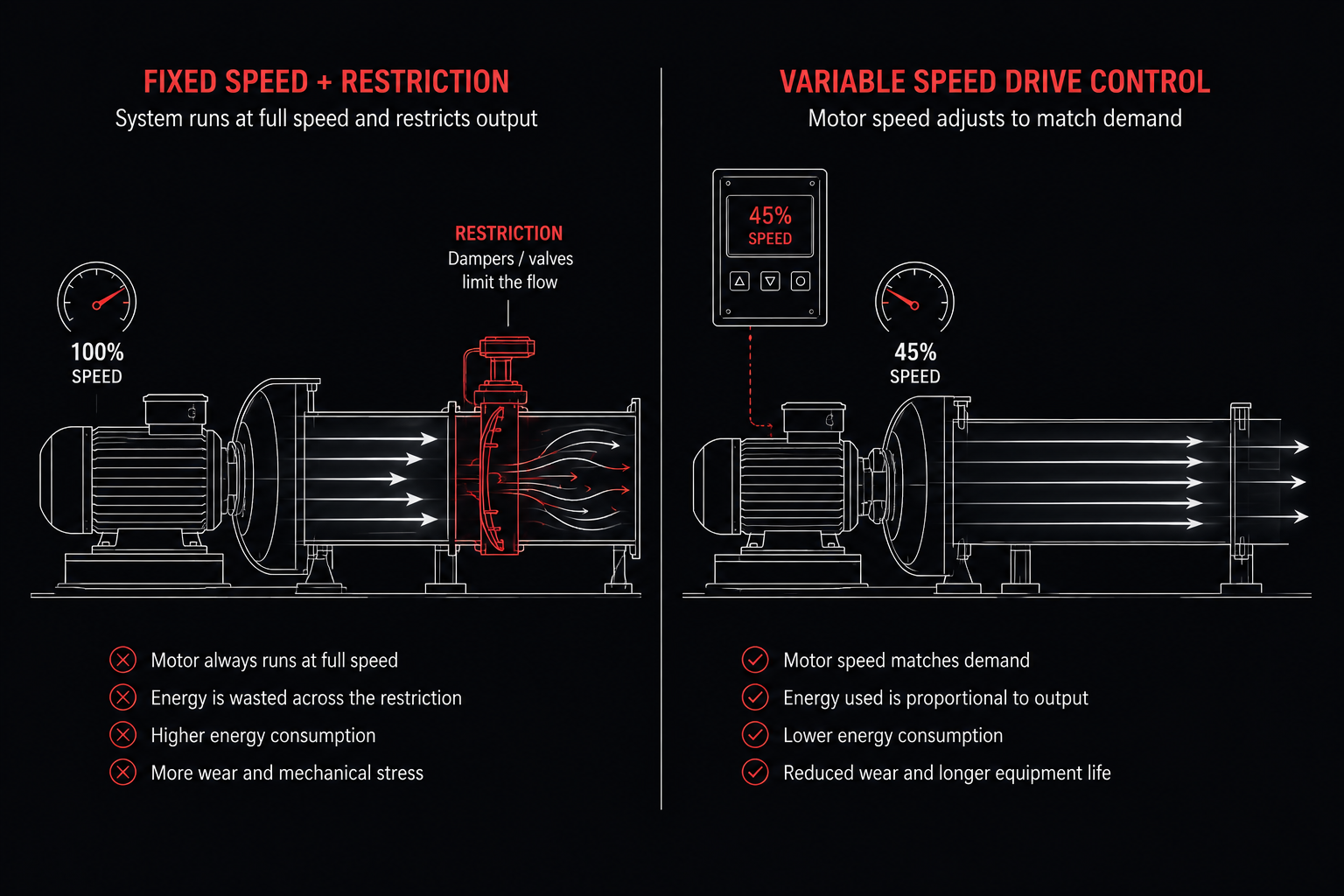
Instead of reducing output, they restrict it using dampers or valves. While this limits flow, it does not reduce energy consumption.
The system is still doing the same amount of work, you’re just not using it.
Why Buildings Waste Energy in HVAC and Pump Systems
Most building systems are designed to cope with peak demand.
That makes sense, you need capacity for the busiest or most demanding conditions.
The problem is they’re often left running like that all day.
In reality, demand is constantly changing:
- Occupancy rises and falls
- External temperatures shift
- Usage varies throughout the day
Yet many systems don’t respond to this.
Instead, they continue running at full speed, and output is controlled using dampers, valves or throttling.
It looks like control.
In reality, it’s restriction.
Where Energy Is Wasted in HVAC, Pumps and Ventilation
You’ll see this most clearly in HVAC systems and pumps.
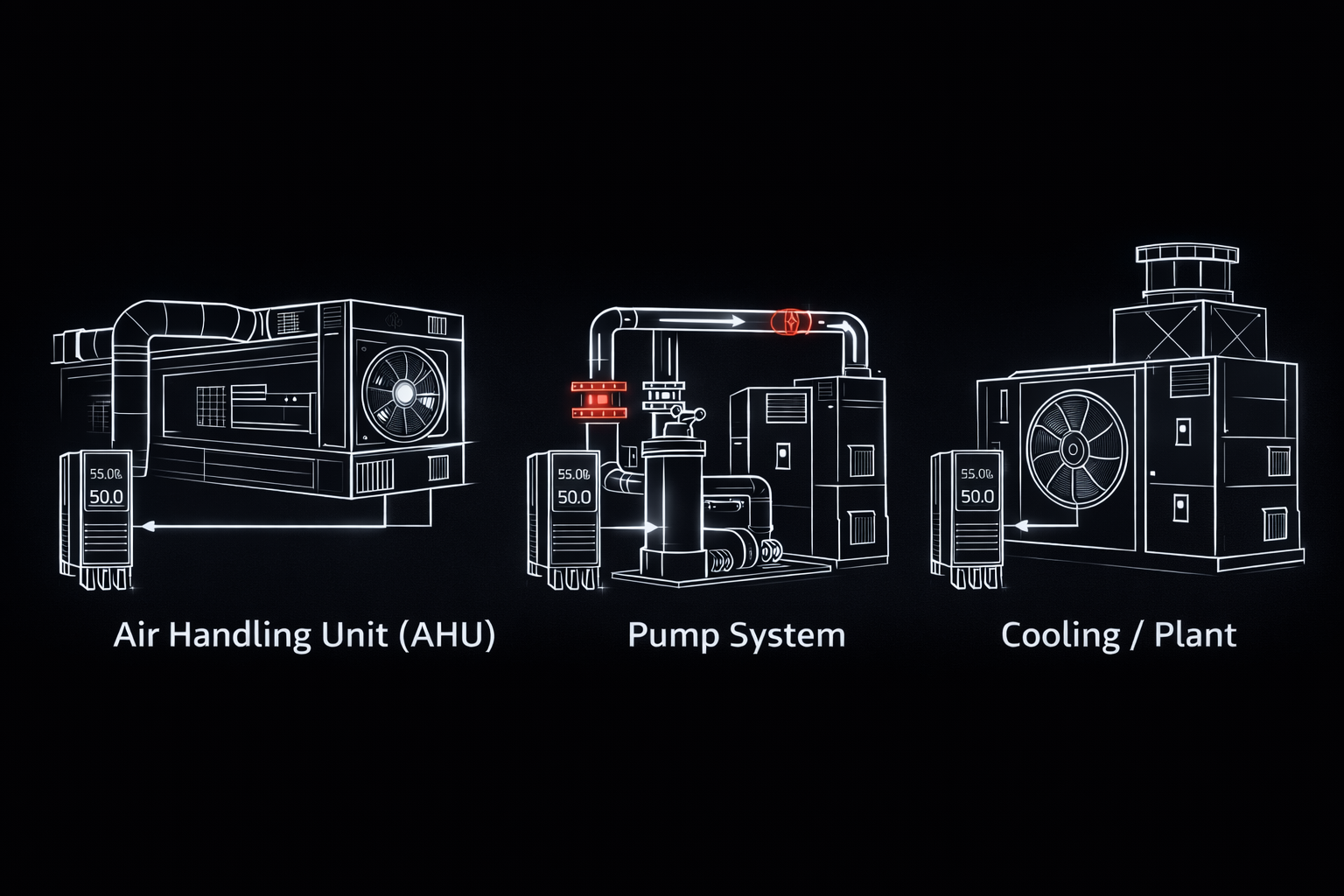
Air handling units are often set to run continuously at a fixed speed. When demand drops, airflow is restricted rather than reduced at source.
The same applies to pump systems. Whether it’s heating, cooling or water circulation, pumps frequently run at full speed regardless of what the building actually needs.
From an operational point of view, nothing appears wrong.
But from an energy perspective, the system is doing far more work than necessary.
The Part Most Buildings Miss
This is where the biggest opportunity sits.
When you reduce motor speed, energy use doesn’t fall slightly.
It falls dramatically.
For systems like fans and pumps, even a small reduction in speed can lead to a significant reduction in energy consumption.
For example:
Reduce speed by 20%, and energy use can drop by up to 50%.
That’s not a marginal improvement.
It’s the difference between a system running efficiently and one quietly wasting energy all day.
Why This Often Goes Unnoticed
Inefficiency rarely presents as a clear problem.
Systems don’t fail. They don’t stop.
They just run.
Because of that:
- There’s no immediate trigger to investigate
- Energy waste becomes part of normal operation
- Costs increase gradually rather than suddenly
Without review or optimisation, systems continue operating at full capacity—even when it isn’t needed.
How do Variable Speed Drives reduce energy consumption?
Variable Speed Drives reduce energy use by adjusting motor speed to match real demand.
Instead of running at full speed continuously, the motor slows down when less output is required and increases speed when demand rises.
This significantly reduces energy consumption, particularly in HVAC systems, fans and pump applications.
How Variable Speed Drives Reduce Energy Use
Variable Speed Drives allow systems to respond to real demand, rather than operating at a fixed output.
Instead of running at full speed and restricting flow, the motor itself adjusts.
When demand is lower, the system slows down.
When demand increases, it responds.
You’re no longer controlling output after the fact, you’re controlling it at the source.
Where are Variable Speed Drives most effective?
Variable Speed Drives are most effective in systems where demand changes, including:
- HVAC systems and air handling units
- Heating and cooling pumps
- Ventilation systems
These are typically some of the largest energy users in a building and often the biggest opportunity for improvement.
It’s Not Just About Energy
Energy savings are often the starting point, but they’re not the full picture.
When systems run at lower speeds:
- Mechanical stress is reduced
- Components last longer
- The risk of unexpected failure decreases
In practice, this means fewer reactive callouts and more consistent performance across the building.
Knowing Where They Don’t Apply
Variable Speed Drives aren’t right for every application.
Some systems are already optimised. Others require fixed speed operation for specific processes.
The key isn’t to apply VSDs everywhere.
It’s to apply them where they will make a measurable difference.
Where to Start
The most effective improvements come from understanding how systems are actually operating.
In practice, that means identifying:
- Where motors are running unnecessarily at full speed
- Which systems have fluctuating demand
- Where energy is being used but not required
Without that visibility, improvements are often based on assumption rather than evidence.
Many buildings are using more energy than they need to not because systems are failing, but because they’re not responding to real demand.
Variable Speed Drives provide a practical way to address this.
They don’t change what the system does.
They change how efficiently it does it.
For facilities managers, that means:
- Lower energy costs
- Improved reliability
- Better control over building performance
Want to Go Deeper?
If you want a more detailed look at how Variable Speed Drives work in real facilities environments, read our full guide:
What Facilities Managers Need to Know About Variable Speed Drives
Want to understand how much energy you could save?
Complete the form and a member of our team will review your application and advise whether a Variable Speed Drive solution could deliver measurable energy and cost savings.