
Motor Efficiency Standards and the Rise of SynRM Motors
Electric motors are everywhere in industry: powering pumps, compressors, conveyors, fans and countless other systems that keep facilities running.
What many organisations underestimate, however, is just how much those motors cost to run.
In most industrial environments, the energy required to operate a motor over its lifetime is far greater than the purchase price of the motor itself. In fact, the purchase cost often represents less than 5% of the total lifetime cost.
That reality is one of the main reasons governments continue to tighten motor efficiency standards, pushing industry towards more efficient technologies and smarter system design.
For businesses operating large numbers of motors, these changes are not just about compliance, they represent an opportunity to reduce operating costs, improve reliability and support sustainability goals.
The Hidden Cost of Running a Motor
When selecting a motor, the focus is often on the purchase price. In reality, the cost of buying a motor represents only a small fraction of its total lifetime cost.
Most of the cost comes from electricity consumption over years of operation.
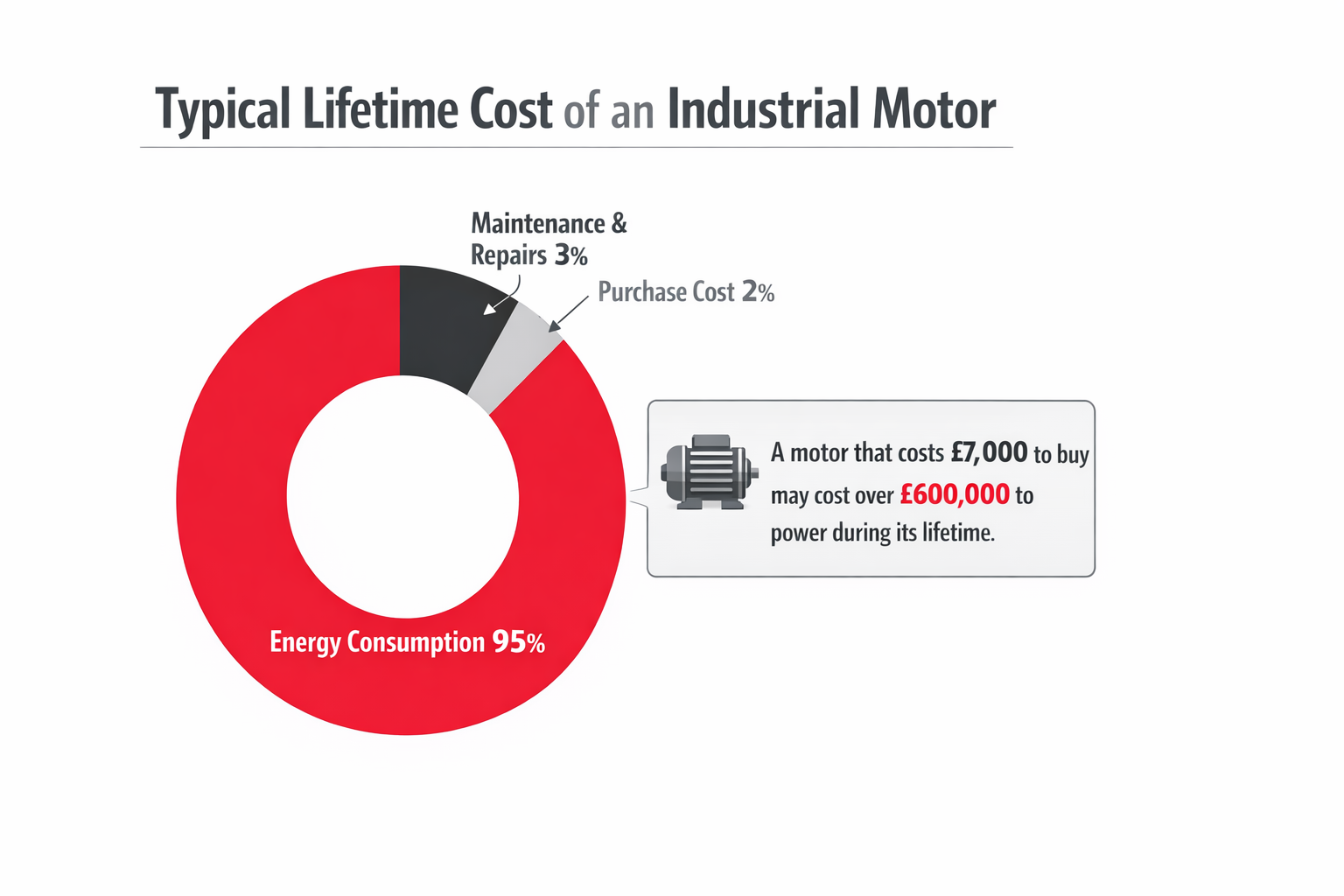
Typical lifetime cost breakdown
- Purchase Cost: 2–3%
- Maintenance & Repairs: 2–3%
- Energy Consumption: 94–96%
A motor that costs only a few thousand pounds to purchase may consume hundreds of thousands of pounds worth of electricity during its lifetime.
This means that even small improvements in efficiency can deliver substantial long-term savings.
Because of this, modern motor selection increasingly focuses on lifecycle cost rather than purchase price alone.
Understanding Motor Efficiency Classes
Motor efficiency is measured using internationally recognised IE (International Efficiency) classes, which indicate how efficiently electrical energy is converted into mechanical power.
- IE1 – Standard efficiency
- IE2 – High efficiency
- IE3 – Premium efficiency
- IE4 – Super-Premium efficiency
- IE5 – Ultra-Premium efficiency
Across Europe and the UK, Ecodesign regulations have steadily raised the minimum efficiency levels required for industrial motors, with IE3 and IE4 now forming key regulatory benchmarks depending on motor type and application
As these standards continue to evolve, many organisations are reviewing whether older motor systems should be replaced with higher-efficiency alternatives.
However, it is important to recognise that IE classes primarily describe traditional motor technologies operating within defined testing conditions.
They do not fully capture the performance potential of newer motor designs and motor-drive combinations.
While IE5 is currently recognised as ultra-premium efficiency, newer motor technologies are already pushing beyond these classifications, with early developments moving towards what is being described as IE6 “hyper-efficiency”.

Moving Beyond IE5: Where Efficiency is Heading
While IE5 is widely considered ultra-premium efficiency, motor technology is already moving beyond these established classifications.
Manufacturers are now introducing IE6 “hyper-efficiency” motors, signalling the next step in reducing energy consumption in industrial applications.
For example, ABB has announced that its synchronous reluctance (SynRM) motors are now available in IE6 efficiency versions as standard across certain ranges. These magnet-free motors are designed to deliver significantly improved performance, with reported energy savings improvements of up to 76% compared to IE4 machines.
Available in ratings from 100kW to 450kW, these motors demonstrate how quickly efficiency expectations are advancing.
Importantly, IE6 is not yet part of formal regulatory frameworks. Instead, it represents the direction of travel for motor development.
For businesses, this shifts the conversation from:
meeting minimum standards
to
identifying the most efficient solution over the full lifecycle of the system.
SynRM Motors – A Step Change in Efficiency
One technology at the centre of this shift is the Synchronous Reluctance Motor (SynRM).
Unlike traditional induction motors, SynRM motors are designed to minimise rotor losses and operate with significantly higher efficiency, particularly when paired with a variable speed drive.
In many applications, modern SynRM motor and drive combinations are now achieving performance levels aligned with, or exceeding, IE5 and moving into IE6 efficiency territory. This effectively positions SynRM technology not just as a high-efficiency option, but as one of the first widely available motor solutions operating at IE6 “hyper-efficiency” levels.
This is a fundamental shift.
Rather than incremental gains within existing motor designs, SynRM represents a different approach to how motors convert electrical energy into mechanical output.
Key benefits of SynRM motors include:
- very high efficiency in drive-controlled applications
- reduced electrical losses
- lower operating temperatures
- improved reliability in suitable applications
- no reliance on rare earth magnets
- strong lifecycle cost performance
When combined with advanced drive systems, SynRM motors can deliver significant reductions in energy consumption, particularly in variable load applications such as pumps and fans.
Drives and Motor Efficiency
Motor efficiency is not just about the motor itself. The complete motor and drive system plays a major role in overall energy performance.
Variable speed drives allow motors to operate at the exact speed required by the process, rather than running continuously at full output.
This can deliver a number of operational benefits:
- reduced energy consumption
- improved process control
- reduced mechanical stress on equipment
- improved system reliability
Modern high-efficiency motors, particularly technologies like SynRM, are designed to work in combination with drives, delivering optimal performance as a complete system rather than as standalone components.
As motor technology continues to evolve, IE6 “hyper-efficiency” motors are already entering the market. We explore what IE6 means in practice, and where it can deliver real energy savings, in more detail in our article:
IE6 Motors: What ‘Hyper-Efficiency’ Really Means for Industrial Energy Costs
Looking Beyond Like-for-Like Replacement
When a motor fails, the instinctive response is often to install a direct replacement.
However, tightening efficiency regulations, rising energy costs and the emergence of higher-efficiency technologies mean many organisations are now reassessing this approach.
Instead of replacing like-for-like, there is increasing value in reviewing:
- whether a higher-efficiency motor technology could be used
- whether a drive should be introduced or optimised
- whether the system is correctly sized and controlled
In many cases, the best outcome comes from reviewing the complete system, rather than replacing a single component.
As motor technology continues to evolve, IE6 “hyper-efficiency” motors are already entering the market. We explore what IE6 means in practice, and where it can deliver real energy savings, in more detail in our article:
IE6 Motors: What ‘Hyper-Efficiency’ Really Means for Industrial Energy Costs
Looking Ahead
Efficiency standards will continue to evolve as industry looks for ways to reduce energy consumption and improve sustainability.
But the real shift is already happening.
The conversation is moving beyond compliance-driven upgrades towards performance-led decision making.
Technologies such as SynRM, now progressing into IE6 efficiency levels, are redefining what is possible in motor efficiency.
For businesses, this presents a clear opportunity:
to reduce operating costs
to improve system reliability
and to future-proof motor and drive investments
Because when motors run thousands of hours each year, even small improvements in efficiency can translate into significant savings over the long term.
At IDS, we regularly help customers review motor and drive systems to identify opportunities for improving efficiency, reliability and long-term performance.
Want to understand how much energy you could save?
Complete the form and a member of our team will review your application and advise whether a Variable Speed Drive solution could deliver measurable energy and cost savings.