
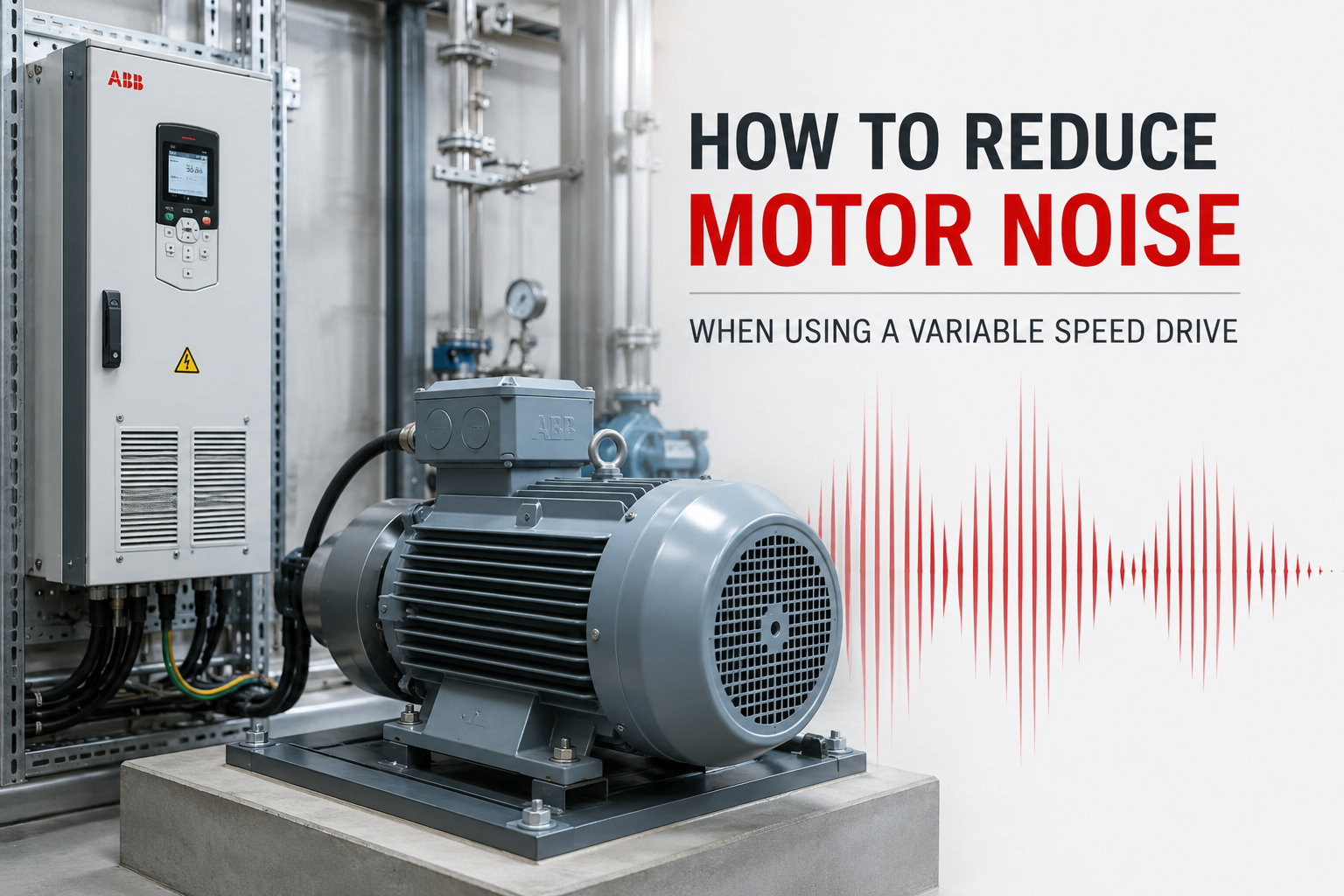
How to Reduce Motor Noise When Using a Variable Speed Drive
Variable Speed Drives (VSDs) offer significant benefits in terms of energy efficiency, process control and reduced mechanical wear. However, one of the most common questions asked after a drive installation is:
“Why has my motor started making a high-pitched whining noise?”
In many cases, the answer is completely normal and is directly related to how a Variable Speed Drive controls motor speed.
This article explains why motor noise occurs when using a VSD, what causes the characteristic motor whine, how ABB drives can help reduce it, and the practical steps that can be taken to minimise noise without compromising system performance.
How a Variable Speed Drive Controls Motor Speed
A standard AC induction motor connected directly to the mains runs at a fixed speed determined by the supply frequency.
A Variable Speed Drive allows motor speed to be adjusted by converting the incoming electrical supply into a controlled output frequency and voltage.
The process typically follows four stages:
AC Supply → Rectifier → DC Bus → Inverter Stage → Variable Frequency Output
The inverter stage rapidly switches electronic power devices on and off thousands of times per second to create the required output waveform. This switching process is fundamental to how a Variable Speed Drive operates, but it is also the source of the motor noise that many users notice.
To learn more about how a Variable Speed Drive converts incoming AC power into a variable frequency output, read our guide: How Does a Variable Speed Drive Work?
How a Variable Speed Drive Creates Variable Speed
AC Supply → Rectifier → DC Bus → Inverter → Motor
Why Does a Motor Whine When Connected to a Variable Speed Drive?
The high-pitched sound often associated with a Variable Speed Drive is usually caused by the drive’s switching frequency.
Inside the drive, power transistors switch on and off extremely quickly to create a Pulse Width Modulated (PWM) output waveform. These pulses generate magnetic forces within the motor that can cause the stator laminations and windings to vibrate slightly.
Those vibrations become audible as a characteristic whine or high-frequency tone.
The motor itself is not necessarily faulty, and the noise does not automatically indicate a problem with the drive installation.
In many industrial applications, this sound is considered completely normal.
Why Does a Motor Whine?
Variable Speed Drive → PWM Switching → Magnetic Forces → Motor Vibration → Audible Noise
What Is Switching Frequency?
Switching frequency refers to how many times per second the drive’s power transistors switch on and off.
Typical switching frequencies range from around 1kHz to 16kHz depending on the drive model and application requirements.
The switching frequency directly influences both motor noise and drive efficiency.
At lower switching frequencies:
- Motor noise is generally more noticeable
- Drive losses are lower
- Drive efficiency is slightly higher
At higher switching frequencies:
- Motor noise is reduced
- Drive losses increase
- Additional heat is generated within the drive
For many industrial applications, around 4kHz often provides a good balance between efficiency and noise levels.
The characteristic motor whine that many people notice often sits within the normal hearing range of adults. Increasing the switching frequency can move this noise beyond the range that most people can hear, making the motor appear much quieter.
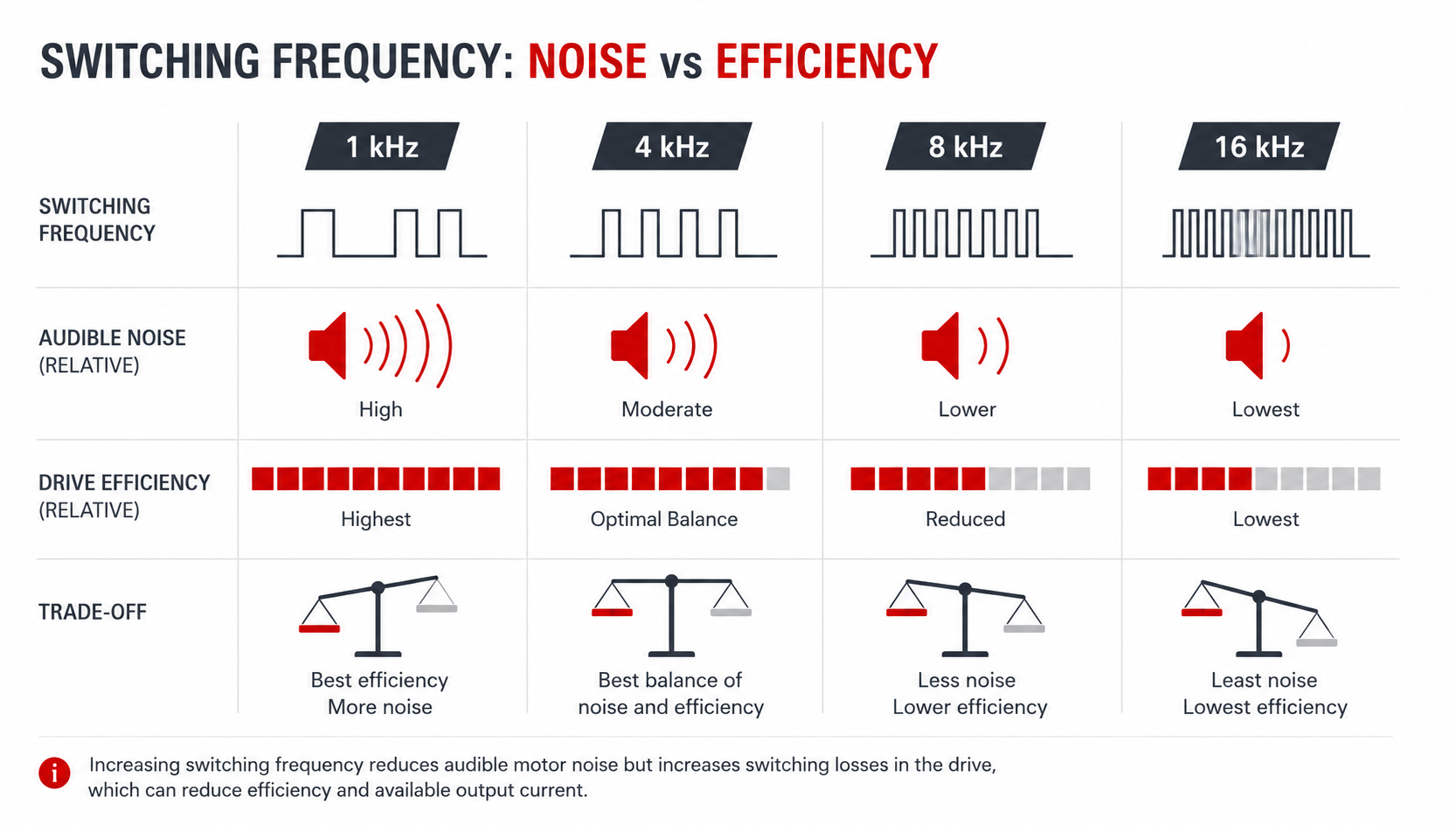
Switching Frequency vs Audible Noise
1kHz → Loudest
4kHz → Typical Industrial Setting
8kHz → Reduced Noise
16kHz → Quietest Operation
Higher frequencies reduce noise but increase drive losses.
Why Not Simply Set Every Drive to 16kHz?
A common assumption is that increasing switching frequency is always the best solution.
While increasing switching frequency can significantly reduce audible motor noise, there is a trade-off.
Higher switching frequencies create additional switching losses inside the drive. This results in:
- Increased heat generation
- Reduced drive efficiency
- Potential drive derating
- Increased thermal loading on power components
In practical terms, a drive operating at higher switching frequencies may require a reduction in its available output current compared to operation at lower switching frequencies.
For this reason, many engineers only increase switching frequency where noise reduction is genuinely required.
It is also worth noting that increasing switching frequency does not always eliminate motor noise completely. The final noise level will depend on factors such as motor design, installation quality, mounting arrangements and the application itself.
How to Reduce Motor Noise in Practice
If motor noise is becoming a concern, a structured approach is recommended.
Confirm the Noise Is Normal VSD Switching Noise
A high-pitched whine that appears after the installation of a Variable Speed Drive is often completely normal.
Before making any changes, it is important to determine whether the sound is related to switching frequency or whether another issue may be present.
Review the Drive Parameters
Many ABB Variable Speed Drives allow the switching frequency to be adjusted.
Increasing the switching frequency can often reduce the audible noise level significantly.
Enable Noise Reduction Features
Where available, ABB’s noise smoothing functionality can reduce the perception of a continuous tonal noise by subtly varying the switching frequency over time.
Monitor Drive Loading
If switching frequency is increased, drive loading and operating temperatures should be checked to ensure the drive remains within its design limits.
Consider the Installation Environment
In noise-sensitive locations such as hospitals, offices and hotels, additional acoustic measures may sometimes be justified alongside drive parameter adjustments.
ABB Drive Features for Noise Reduction
ABB Variable Speed Drives include several features designed to help reduce audible motor noise without unnecessarily compromising performance.
Adjustable Switching Frequency
Many ABB drives allow the switching frequency to be adjusted to suit the application.
Where noise reduction is important, increasing the switching frequency can move the audible tone beyond the hearing range of many people.
This can be particularly beneficial in occupied environments where background noise levels are low.
Noise Smoothing
ABB drives also offer a noise smoothing function.
Rather than operating continuously at a fixed switching frequency, the drive subtly varies the switching frequency over time.
This reduces the perception of a constant tonal noise and can make the sound significantly less noticeable to building occupants.
The result is often a more comfortable acoustic environment without requiring the switching frequency to be permanently increased to its maximum setting.
Where Motor Noise Matters Most
In many manufacturing facilities, a moderate level of motor whine is rarely a concern.
However, some environments are far more sensitive to noise.
Examples include:
- Hospitals
- Healthcare facilities
- Schools and universities
- Office buildings
- Hotels
- Laboratories
- Public buildings
- HVAC and air handling systems
In these applications, even relatively low levels of motor noise can become a nuisance, particularly where equipment operates continuously.
This is especially common in Air Handling Units (AHUs), ventilation systems and building services applications where background noise levels are lower than in a typical industrial environment.
Careful drive selection, commissioning and parameter optimisation can help minimise noise while maintaining system performance.
Many building services applications can also benefit from intelligent drive control strategies that optimise performance while reducing energy consumption. Learn more in our guide to Intelligent Pump Control.
When Motor Noise May Indicate a Problem
While switching-frequency noise is usually normal, not every unusual motor sound should be ignored.
A high-pitched motor whine is often a characteristic of Variable Speed Drive operation. However, if the noise is accompanied by vibration, overheating, mechanical sounds or frequent drive trips, further investigation may be required.
The guide below can help distinguish between normal VSD operation and symptoms that may indicate a developing fault.
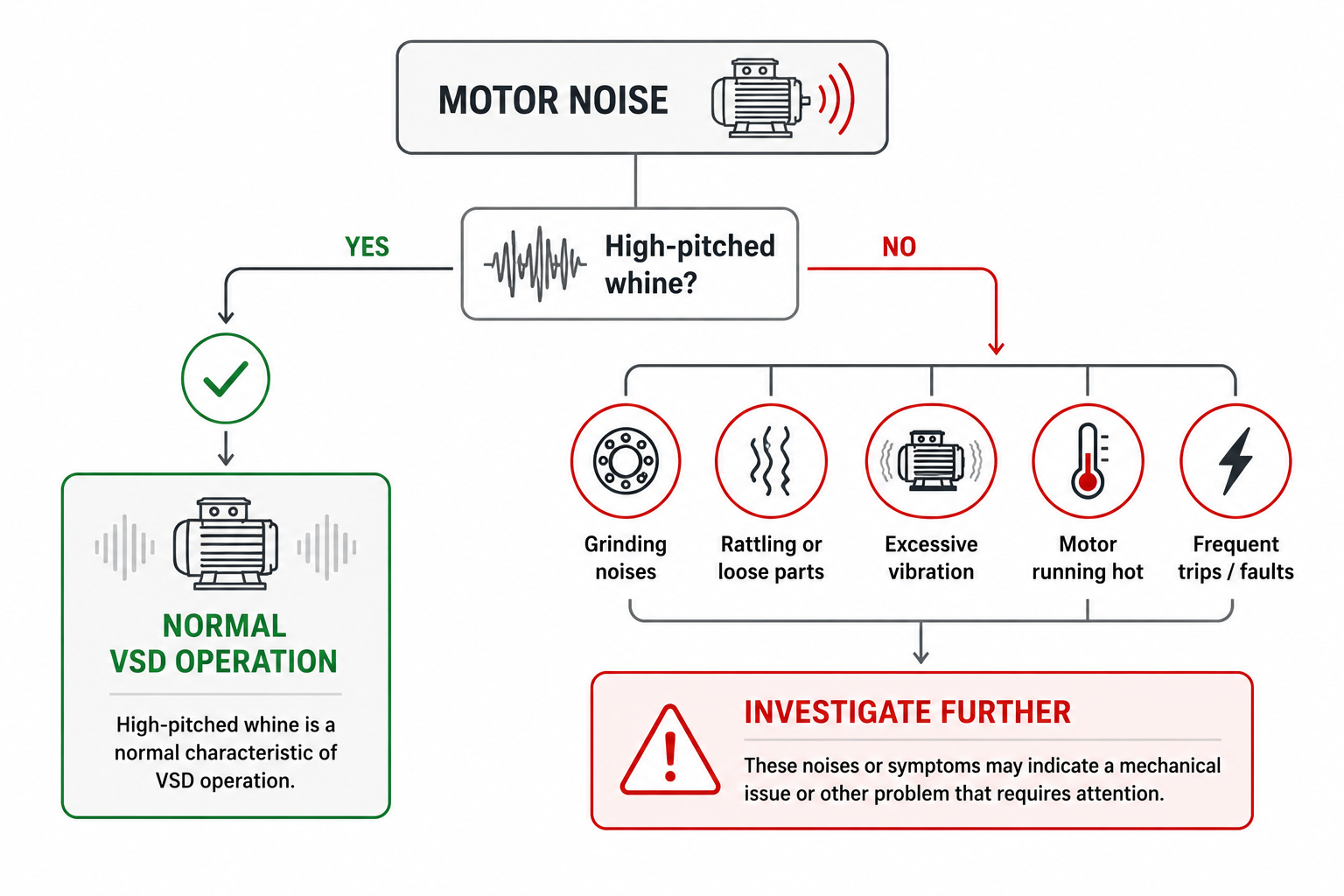
Motor noise may indicate an underlying issue if it is accompanied by:
- Excessive vibration
- Mechanical rattling
- Bearing noise
- Overheating
- Unexpected drive trips
- Changes in noise level over time
Potential causes include:
- Bearing wear
- Mechanical resonance
- Incorrect motor parameters
- Poor commissioning
- Loose components
- Harmonic-related issues
If motor noise changes suddenly or appears abnormal, further investigation may be required.
Motor Noise Troubleshooting
Motor Noise
↓
Normal VSD Whine?
↙ Yes ↘ No
Adjust Switching Frequency Investigate Bearings, Commissioning and Mechanical Issues
If you’re investigating unusual motor behaviour, recurring drive faults or suspected equipment issues, our guide to Maintaining and Repairing Variable Speed Drives explores common causes, preventative maintenance and troubleshooting considerations in more detail.
Frequently Asked Questions
Can a Variable Speed Drive damage a motor?
When correctly specified and commissioned, a Variable Speed Drive should not damage a motor. Modern drive systems are designed to operate safely with suitable motors and application requirements.
Why is my motor noisier after fitting a VSD?
The most common reason is the introduction of PWM switching frequencies that create audible magnetic vibration within the motor.
Does increasing switching frequency save energy?
No. Increasing switching frequency generally reduces motor noise but slightly increases drive losses.
What is noise smoothing?
Noise smoothing is a function available on many ABB drives that varies the switching frequency to reduce the perception of a constant tonal noise.
Can all ABB drives reduce motor noise?
Many ABB Variable Speed Drives include adjustable switching frequencies and noise optimisation functions, although available features vary between product ranges.
Is motor whine a sign that something is wrong?
Not usually. A high-pitched motor whine is often a normal consequence of Variable Speed Drive operation. However, sudden changes in noise, excessive vibration or mechanical sounds should be investigated.
Balancing Noise Reduction and Efficiency
Motor noise is one of the most common concerns raised following the installation of a Variable Speed Drive, but in many cases it is simply a normal consequence of PWM motor control.
Where noise reduction is important, ABB Variable Speed Drives provide several options to minimise audible motor whine, including adjustable switching frequencies and noise smoothing functions.
The key is finding the right balance between acoustic performance, drive efficiency and system reliability.
In many industrial environments, a modest amount of motor whine is perfectly acceptable and often represents the most efficient operating point. In noise-sensitive applications, however, careful parameter adjustment can significantly improve the acoustic environment.
If you’re experiencing excessive motor noise or would like advice on configuring an ABB Variable Speed Drive for a noise-sensitive application, IDS can help.
Talk to IDS
Whether you’re commissioning a new drive system, upgrading existing equipment or troubleshooting a noisy installation, our engineers can help identify the most appropriate solution for your application.
Call 0115 944 1036, email [email protected] or contact us through our website.
Want to understand how much energy you could save?
Complete the form and a member of our team will review your application and advise whether a Variable Speed Drive solution could deliver measurable energy and cost savings.